

Interview in the Armenian Weekly, December 24, 2011
Diana Der-Hovanessian: 'I Write Almost Every Day'
by Artsvi Bakhchinyan
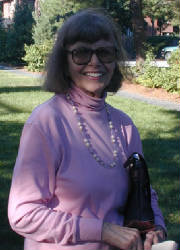
Diana Der-Hovanessian, New England born poet, was twice a Fulbright professor of American Poetry and is the author of more than 25 books of poetry and translations. She has awards from the National Endowment for the Arts, Poetry Society of America, PEN/Columbia Translation Center, National Writers Union, Armenian Writers Union, Paterson Poetry Center, Prairie Schooner, American Scholar, and the Armenian Ministry of Culture. Among the several plays written by Der-Hovanessian, two (The Secret of Survival and Growing Up Armenian) were produced and in 1984 and 1985 traveled to many college campuses in the 80s telling the Armenian story with poetry and music. After 1989, The Secret of Survival with Michael Kermoyan and later with Vahan Khanzadian was performed for earthquake relief benefits. She works as a visiting poet and guest lecturer on American poetry, Armenian poetry in translation, and the literature of human rights at various universities in the U.S. and abroad. She serves as president of the New England Poetry Club. The following interview by Artsvi Bakhchinyan was conducted in the poet’s home in Cambridge.
Diana Der-Hovanessian
AB: This year, you added three new books to your publications. How many does that make?
DDH: Fifteen of my own books and 10 volumes of translations.
AB: The new translations are compiled in Armenian Poetry of Our Time. And the book starts with 20th-century greats such as Daniel Varoujan, Siamanto, and Tekeyan, and goes on to young contemporary poets such as Vahe Arsen. Do you think of translating as part of your own work? Do you consider it an obligation? Or is it a way of being part of great poetry you admire?
DDH: I’ll answer yes to all those questions. Translating isn’t as much fun as creating something new. And, it has a lot of responsibilities attached. But I started because there was no contemporary anthology of Armenian poetry in English. Some individual poems had been translated by past poets, even Henry Longfellow. But in 1896, working from literal prose translations from Armenian scholars and friends, Alice Stone Blackwell produced the first edition in English of Armenian Poems. Then in 1917 for Near East Relief, and to call attention to the murder of Armenian poets in 1915 and the genocide, she added more poems and published another edition.
AB: Alice Stone Blackwell was a great friend of Armenians and a humanist. But she was not a poet. Do you think her translations hold up?
DDH: Of course, they are dated. She uses 18th- and 19th-century phrases. For instance, she begins Bedros Tourian’s Little Lake: “Why dost thou lie in hushed surprise, Thou little lonely mere?” It’s too bad that Julia Ward Howe, who was also active (she was president of the Friends of Armenia), did not do some of the poems. She was a known poet.
AB: Alice Stone Blackwell’s book has long been out of print, I believe. Was that why you started?
DDH: Before I had any book publications, but was publishing poetry in journals and newspapers, a Bulgarian poet asked me to work with him on an anthology of Bulgarian poetry. And I said, “No, I can’t do that…when there isn’t a modern Armenian anthology.”
AB: And you began…
DDH: I started it with my father. We had already done a few translations together. The first were for a concert the Boston Pops was doing of Armenian sharagans for his friend, the conductor Rouben Gregorian. And the second, for a lecture on Daniel Varoujan my hayrig [father] was giving and wanted six poems in English for that program. I was publishing poems already in those days…and when I saw how the Varoujan turned out, I sent them to one of my editors who surprised me by taking the whole batch.
AB: And that’s how you started?
DDH: No. Actually another editor of mine invited me to lunch and said she was thinking of starting a page, at the Christian Science Monitor, of international poems and wanted me to do some Armenian, I told her I didn’t know Armenian that well. This was a long time ago. And she looked at me, and said, “Well, you’re young. Learn it!” So I did, I took every course offered at Harvard. And every course at Boston University. But, also, I had lots of help. After my father’s death many friends sent me poems, or read to me. And of course, my students in Armenia would run around gathering books. And poets, of course, would come to read to me. The only book I did all alone was the volume of Derian. I did it with a dictionary and then had it checked. The Koutchag, too. Strangely enough, I didn’t find Koutchag’s dialect difficult. It sounded similar to the dialect my grandmother had spoken to me. But Sayat Nova was hard. And most intimidating was Narek, even though I worked from modern Armenian translations of the old krapar (classical Armenian). For the first anthology, I did the Narek with the help of Hayr Oshagan, a priest at Holy Trinity Church in Cambridge. And for the book of Narek, translations were done with Tom Samuelian… He would send a driver every morning with word-for-word translations done by a priest when I was in Yerevan on a Fulbright. And then when I returned to Boston the rest were sent by e-mail.
AB: How do you choose which poems to include in an anthology?
DDH: I think a translator often does a poem he wishes he could have written himself. Or else it is a very important poem, pivotal in some historic aspect, and must be done. For instance, I had to translate Bedros Tourian for the first anthology because he was important historically… He was the first to use vernacular Armenian and write about personal themes.
AB: But you didn’t like Tourian?
DDH: No, although he was my mother’s favorite. He did have one great poem, “Drdounch.” My rules for translating include three debts the translator owes: 1) The translator owes the reader the poem the original poet wrote. 2) The translator owes the original poet the best possible version in the second language. The original poet’s reputation is in his hands. 3) The translator owes the poem a vibrant second life in the second language.
AB: You did a large volume of Charents with M. Margossian. And some of those translations were used in a recent film made in Yerevan. Is Charents one of your favorite poets?
DDH: Not when I started. During the five years I was translating Charents, I would dream about him. We would have arguments in these dreams. On my first trip to Armenia I was working on that book…and met his daughters and spent a lot of time with Anahid.
AB: During another trip I took you to meet the late Regina Ghazaryan, a friend of Charents’s who had buried some of his papers.
DDH: Oh yes, yes, yes. That was an unforgettable meeting. It is important to meet people who personally know the authors you translate. I hope they remember Regina in Armenia.
AB: One of your new books is Dancing at the Monastery. It has a lot of prosy poems. Have you abandoned formal verse and rhyme?
DDH: No, my very newest manuscript has a larger share of sonnets and villanelles, etc.
AB: But the brand new book, just out this month, from Cervana Barva Press, NOW I SEE IT, is in shapes.
DDH: Actually those poems are just published, but were written a while ago. My editor at Sheep Meadow Press would also take out any light or humorous verse, any strange shapes. But in the last few books he allowed sections of light verse. By the way, I’m a great admirer of Charents’s light and satiric verses. I enjoyed translating those.
AB: And you didn’t have dreams then about arguing with him about those?
DDH: (Laughs) No! But to get back to the shaped poems, in the 16th century, English poet George Herbert did some religious poems in the shapes of altars and wings, and more recently in the 50s in Brazil and Germany some artists were combining strewn words on posters and art and calling the movement Concrete Poetry.
AB: Tell me a little bit about your writing habits. Do you write every day? Do you rewrite? Do you keep old versions? You did a recent program with an American poet, X.J. Kennedy, titled, “Where Does a Poem Come from?” Did you two decide where poems come from?
DDH: We decided, of course, that they come from poets. And they come to poets from the most unexpected places: a news item, a remembered conversation, someone else’s poem you wish to answer, a dream. A lot of poems used to come to me when I was half-asleep and I would get up to write them down. Now…I just ignore them. But I do write almost every day…mostly rewriting. And I throw most of it away or my house would be filled with paper. Even more than now! I do write on paper first. Then type it into the computer and keep changing it. What takes up most of my time is the New England Poetry Club: planning programs, finding judges for contests, introducing speakers, answering mail. I am hoping to retire from it soon. We have a good vice-president.
AB: Well I hope the Varoujan Prize and programs on translations that you started will continue.
DDH: I hope so, too.
AB: I have one last question. I think you have often been asked, Have you thought of writing a memoir? After all, you have known and worked with some of the biggest names, not only in Armenian poetry but world poetry: Andrey Voznesensky, Bella Akhmadulina, Tomas Tranströmer, Yevgeni Yevtushenko, Czesław Miłosz, Seamus Heaney.
DDH: (Laughs) Mmm.
Diana Der-Hovanessian Featured in Ibbetson Review #32, November 2012
An Interview by Adria Holmes
The December Issue of Ibbetson Review, based in Somerville, Mass., features the work of Diana Der-Hovanessian, longtime president of the New England Poetry Club. As poet Doug Holder says, not only has she directed the poetry organization for decades, arranging countless readings by world-renowned, as well as local poets but she has also won numerous awards for her own poetry and poetry collections. She has written extensively about the Armenian Genocide and has been a strong voice making sure this holocaust will not fall into the dustbin of history.
Adria Holmes: How did your presidency of New England Poetry Club come to be?
DDH: Well, reluctantly I must say. I was taking a class at Harvard, actually the last class, Robert Lowell gave. and someone, before the class began, told us all about a poetry reading that evening at the Faculty Club. And I went to hear the New England Poetry Club program. In those days there were daily poems on the editorial pages of The Times, the Trib, the Monitor, in pages of Yankee, Saturday Review, Harpers. There was a lot of poetry being published. It was easier in those days and I was selling a lot of it, since I had given up full time writing jobs to do free lance and take care of two babies.
AH: So you went to that meeting…
DDH: After the reading, there was a lot of socializing. I had not met any other poets here in Boston. I used my married name with acquaintances so no one, really, except my family knew me as DDH and I was startled that so many at the club, knew me from published stuff! In fact the president at the time, Victor Howes, asked me to join: even asked me to be secretary!
AH: And that was the beginning.
DDH: Well no, I said I didn’t know shorthand and wouldn’t make a good secretary. And he laughed saying no, no, not that kind. He had a secretary at his university. I would merely send notices of meetings to the printer who’d send cards to the membership. Well, I found myself, also getter speakers for Victor. It was a good partnership. And then after a few years he and the board asked me to be president because I was working at the annual Boston Globe Book Festival arranging poetry readings and panel discussions at the Boston Public Library.
AH: So you started?
DDH: Not for another year. I said, I didn’t know Robert’s Rules, etc., etc. and was willing to continue getting speakers. Not be president. But finally I was talked into it, I’m sorry to say.
AH: You regret it?
DDH: Well, in a way: I wasted a lot of time, arranging meetings, but in other ways, it’s been a different kind of adventure meeting the princes and prima donnas of the poetry world. And arranging a lot of international poetry events.
AH: Did you know Amy Lowell, Robert Frost or Conrad Aiken? And are they still an influence in some ways.
DDH: I heard Robert Frost, once at Harvard. My mother had taken me to that reading! And I heard a lot of Frost and Lowell stories from older members. The club still seems to be a meeting place of both poetry from the academic and the popular world. What I did was bring in a lot more international poetry, which had been Amy Lowell’s early aim. And our current board, especially Fred Marchant, finds Conrad Aiken, still an influence in anti-war and or other poetry of conscience.
AH: I’ve heard that you made a lot of changes in the local poetry scene by moving the usual program hour of 8 p.m. to 7. And inviting more than one poet on a program, giving more poets exposure. Now do you think NEPC would benefit from social media, such as a blog or Twitter?
DDH: You and other younger members will have to tell us and lead.
AH: How do you think the Armenian Holocaust impacted poetry?
DDH: Well, horrifically, of course, because 250 poets were the first to be rounded up and executed! Here, we don’t think of poets as particularly influential or dangerous. But to Armenians, poetry was a way of imparting pride and keeping up hope with references to past heroes. Poets were leaders. This was 1915, when the Turkish Ottoman Empire was falling apart in Europe. Greece and the Bulgarians were the last to be freed and the Turks were afraid the Armenians would be the next to free their lands. So during World War I, (when they were on the side of the Germans) they drafted all the young Armenian men, but instead of being armed and trained, they were all executed. Then the general population was marched into the deserts toward Syria. Most died. No more poets and no more readers.
AH: Oh. Now I can understand its impact on the next generation: and on your work.
DDH: Yes, an intelligent reader should know history should not be rewritten. Evil should not be rewarded. One genocide is as wrong as another. The Turkish success led Hitler to say in 1935, "Who now remembers the Armenians?" when he started on his path.
AH: I have a different question. What do you find the most difficult part of writing?
DDH: Finding enough time, I guess. Rewriting, sending out.
AH: Any advice for writers wanting to be published?
DDH: Don’t be discouraged. Rewrite when and if something comes back. Especially if the editor makes suggestions. When I was young and starting out, no one told me to always send a note telling of previous publications or where you’ve studied. I thought stuff like that was frowned upon. I never knew to rewrite and send back to the editor who made suggestions. I didn’t know anything. I didn’t think of editors as friends: writers themselves who want you to succeed. It was one of my poetry editors who first suggested I do translations from the Armenian.
The interview was followed by seven poems by Diana, including the following:
TO YOU THE LIVING
Greetings!
from us, from the past.
Our message is simple:
Nothing lasts
except honor. Of course
love, also is good
while you’re alive and it is understood
even in memory.
But honor lives past
history. History
depends on the best reports and who owns
the press.
Then it is forgotten by all except the gods
That do exist.
Oh yes,
Against all the odds
they do.
But with different names than you
guessed.
OTHERS
Other people
can have individual sorrows,
personal defeats, and aims.
Not Armenians
They owe two million ghosts
two million debts to claim.
Interview with New England Poetry Club President: Diana Der-Hovanessian with Doug Holder, July 27, 2004, on Poet To Poet/Writer To Writer, Somerville Community Access TV.
Diana Der-Hovanessian is the president of the venerable literary organization: The New England Poetry Club. Based in Cambridge, Mass., it was founded by Amy Lowell, Robert Frost and Conrad Aiken almost ninety years ago. Lowell's vision was to bring well-known poets to large audiences. In the 1960's through the 1980's the club became insular and provincial, with meetings held at the Brahmin enclaves of Beacon Hill and the Harvard Faculty Club. Der-Hovanessian changed this by inviting Russian poets such as: Andrei Voznesenky and Yevtushenko to read at the club. And since then scores of South American and Latin American Poets have visited and read there, as well as prominent American poets such as: Robert Creeley, X.J. Kennedy, Robert Pinsky, and many others. I spoke to Diana Der-Hovanessian on my Somerville Community Access TV show: Poet To Poet/Writer To Writer.
Doug Holder: How did you become involved with the club?
Diana Der-Hovanessian: I joined it when Victor Howes was running things. He asked me to be secretary. I said "I don't do shorthand." (laughs) He said: "No...No. Not that kind of secretary." So for eight years he had me do programming. I became president in 1980. It's been a long time and we are due for another election!
DH: Amy Lowell started the club. She was quite an eccentric character, wasn't she?
DDH: When I first went into the club we had people who actually knew her. They had interesting stories about the early days. She started the club in 1915, when she came back from England. She was under the influence of Imagists, like Ezra Pound. But Robert Frost and a group of Formalist poets took it away from her. Frost, who was the second or third president, got into big fights with the Imagists, in those days.
DH: Lowell's goal was to reach a large audience through poetry and poetry readings. Has this been your goal?
DDH: This vision of expansion had stopped for awhile when I came around. I felt like we should expand. Now we bring in name poets to make it more exciting. We also have our own members read. We also have free workshops for members.
DH: What is the mission of the Club?
DDH: To expand poetry. To bring people into the art. To show off the best. To be a forum for an exchange of ideas.
DH: Can you talk a bit about the poets who have read for you over the years?
DDH: We had an Irish festival some years ago with the help of Seamus Heaney, who is on our board. He brought a lot of poets from Ireland, like: Evan Boland. Some of the Club's other readers over the years have been: Robert Lowell, Robert Creeley Stanley Kunitz, James Merrill, to name just a few.
DH: Did you have a relationship with the Beat poets?
DDH: We did sponsor a reading by Allen Ginsberg. Once I went to the airport to meet a visiting poet, and Ginsberg was there with him. Ginsberg was wearing a tie. He told me that he was dressed up for the Club. I told him that he didn't have to do it. He turned his tie over and said, "Brooks Brothers. I got it at Good Will."
DH: What do you think of the Slam poets and the Hip-Hoppers? DDH: We had a program for them at the Boston Globe Book Festival. There was someone on the Globe who wanted it: Patricia Smith. I thought it was fun. I love the fact that they memorize their poems. I envy them. I could do that when I was young. DH: You are a respected poet in your own right. I believe you are a Fulbright Scholar, and have written extensively about the Armenian Holocaust. Can you talk about your education, and early influences? DDH: I've been a Fulbright Scholar twice. I went to Boston University as an undergraduate. I studied with Robert Lowell at Harvard. I took his last workshop. It was really great. They said he wouldn't show up. But he did. He was there every single week. It was one hour of teaching poetry, and one hour of going over student poems.I completed nine volumes of translations from the Armenian. I have always been interested in the Armenian Holocaust. When the Turks started the genocide against the Armenians in 1915, they started by murdering the leaders. You wouldn't think that poets were the leaders. But they started out by killing two hundred poets.DH: How did you start the Longfellow House readings in Cambridge?DDH: Erica Mumford was a board member. She and I were walking down Brattle St. We looked over at the Longfellow House and said, "Wouldn't this be a perfect place for a reading." We walked in and said, "Don't you want poetry too?" (They had concerts.) And they replied, “Sure, if you want to do it." And that's how it started. It's been going on for almost twenty five years now.DH: Any plans for the 90th anniversary?
DDH: Depends on the funding. We want to bring our Golden Rose prize winners together for a big celebration. We are the oldest reading series in the country.